
TAG GALLERY is thrilled to share a recent article featured in ARTisSpectrum Magazine, spotlighting artist and TAG member, Spencer Frazer (on solo exhibition at TAG Gallery until June 12, 2026).
Article by ARTisSPECTRUM team:
Spencer Frazer’s paintings operate at the intersection of visual storytelling and environmental reflection, constructing intricate pictorial systems that examine the relationship between human activity and the natural world. Rather than presenting nature as a passive subject, his work positions it within a dynamic and often tense dialogue—one shaped by transformation, disruption, and interdependence.
Frazer’s compositions are defined by a highly detailed visual language built from layered patterns, rhythmic linework, and saturated color. These elements do not function as mere decoration; they act as structural components that organize the image into interconnected fields of meaning. Organic forms—waves, flames, vegetation, and wildlife—are woven together with symbolic references to human intervention, creating surfaces that invite both immediate visual engagement and sustained observation.
Influenced by Northwest Indigenous art and Japanese ukiyo-e, Frazer adopts a compositional approach that balances clarity and complexity. His images often unfold as visual tapestries, where multiple narrative threads coexist within a single frame. This multiplicity allows the viewer to navigate the work gradually, uncovering relationships between elements rather than receiving a fixed interpretation.
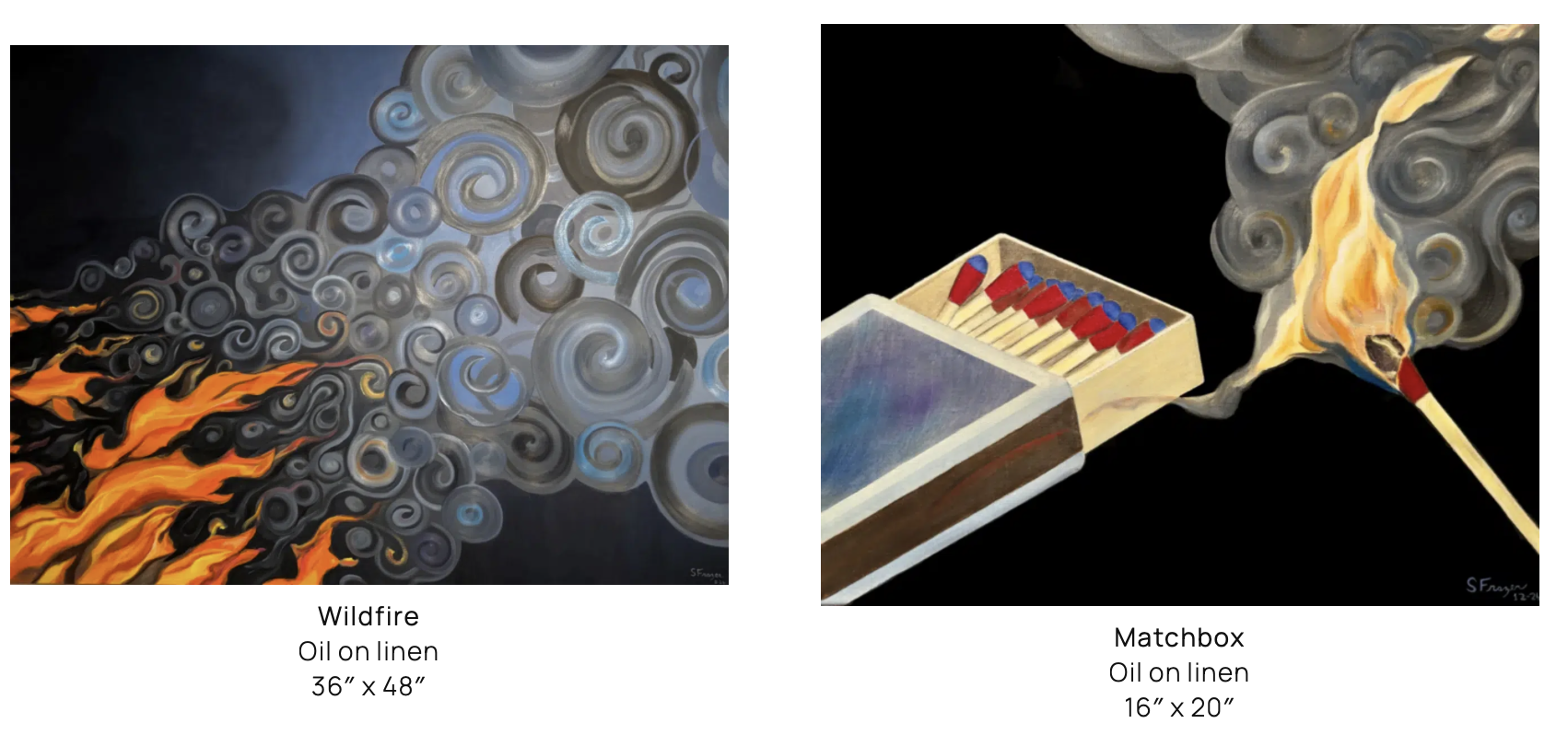
Central to Frazer’s practice is the exploration of environmental imbalance. His paintings address issues such as climate change, deforestation, biodiversity loss, and industrialization—not through direct illustration, but through symbolic juxtaposition. Human presence is frequently implied or embedded within the composition, creating points of tension that challenge the perceived separation between humanity and nature.
This approach is particularly evident in his Combustion series, where Frazer investigates the transformation of energy and its consequences. Fire, smoke, and swirling atmospheric forms become recurring motifs, visualizing processes that are both physical and conceptual. The act of combustion is rendered not only as a scientific phenomenon but as a broader metaphor for consumption, acceleration, and irreversible change.
Despite the conceptual weight of these themes, Frazer’s work maintains a strong sense of visual vitality. Color is used with intention and intensity, guiding the viewer’s attention while reinforcing the emotional charge of each scene. His compositions balance moments of harmony with areas of disruption, mirroring the fragile equilibrium of the ecosystems he depicts.
Frazer’s paintings are not didactic statements, but open systems of inquiry. They encourage viewers to consider their own position within the environmental narratives presented, transforming observation into reflection. In this sense, his work aligns with a broader tradition of art that seeks not only to represent the world but to question our role within it.
Through exhibitions at Agora Gallery, participation in international platforms such as Artexpo New York, and inclusion in curated initiatives focused on environmental consciousness, Frazer’s work continues to engage with audiences attuned to both aesthetic complexity and critical discourse. His contribution to contemporary art lies in his ability to merge visual intricacy with conceptual clarity, creating images that are as compelling to look at as they are to think through.
Ultimately, Spencer Frazer constructs paintings that function as ecosystems in their own right—layered, interconnected, and in constant negotiation. Within them, beauty and urgency are not opposing forces, but part of the same evolving visual language.